


Sometimes we think we know the ocean, but in truth we’re only gazing at the blue from the shore. It isn’t until we step into a lecture like this that we realize the lives, cultures, and memories hidden beneath the sea have always been waiting for us to listen.
1. The Kuroshio Current and Cetaceans of Taiwan: A Flowing Miracle Around Us
Taiwan is surrounded by the sea, and along its eastern coast flows a strong, azure current—the Kuroshio. This ocean current not only shapes our climate and sustains our fisheries but also brings with it the traces of dozens of cetacean species. Did you know? More than 30 species of cetaceans have been recorded in Taiwan’s waters. Off the coast of Hualien, sightings include sperm whales, orcas, and even humpback whales. These are not distant strangers, but lives that breathe and share the ocean alongside us.
2. Sperm Whales: The Whisperers of the Deep
The sperm whale is the largest toothed whale in the world. They dive deep, their calls are low and mysterious—like a quiet and wise traveler writing diaries in the depths with sound waves. These whales can dive thousands of meters to hunt giant squid. In the lecture, we learned not only about their ecology and habits but also the many human misunderstandings and projections placed upon them—from traditional whale-bone crafts to today’s whale-watching tourism. The presence of sperm whales has long shaped our imagination of nature.
3. Technology vs. Taiwan’s Cetaceans: As We “Know” More, Do We Lose Our Sensitivity?
Our era is called the “Information Age,” the “Smart Society.” AI can identify the sound features of whale songs; marine instruments can track cetacean movements in real time; with big data, we can even predict their migration routes and breeding seasons. This all seems convenient, even benevolent, yet it compels us to ask: in trying to get closer, are we unconsciously turning them into predictable objects?
When the speaker spoke of how technology aids cetacean research, his tone carried a trace of helplessness. He said, “Technology is a tool. The real question is whether we use it to build connection—or to assert control.”
This reminder is not only for conservation professionals but also for every one of us who look to the sea in awe. Taiwan sits at the axis of rapid technological progress: we have advanced research resources, ocean observation systems, and image-recording capabilities. Yet at the same time, we witness whales and dolphins gradually retreating from their habitats due to altered shipping routes, sonar interference, and the pressures of tourism.
This distance is not measured in space but in emotion—an alienation and dislocation. Technology may allow us to know their data, but knowing data does not equal understanding life.
If we cannot feel the weight and meaning of their presence in our hearts, then all our records are nothing more than cold coordinates at sea.
4. The Depth of the Ocean Is the Depth of Our Hearts
What lingered with me after the lecture was this line: “We should not only watch cetaceans, but rethink our relationship with them.”
In that moment, I felt an emotion rising from the sea—not dazzling, not dramatic, but a steady pull. Their existence reminds us: respect is both a distance and a choice. A choice to see not only cuteness or grandeur, but to understand their role and meaning within the ecosystem.
Perhaps we should all learn from sperm whales—not rushing to appear, not seeking attention, but speaking to the world in the most genuine way.
May every encounter we have with whales and dolphins in the future be not just an act of watching, but a quiet, profound resonance.
#SpermWhale #CetaceanCulture #TaiwanOcean #EcoEducation #LearningFromTheSea
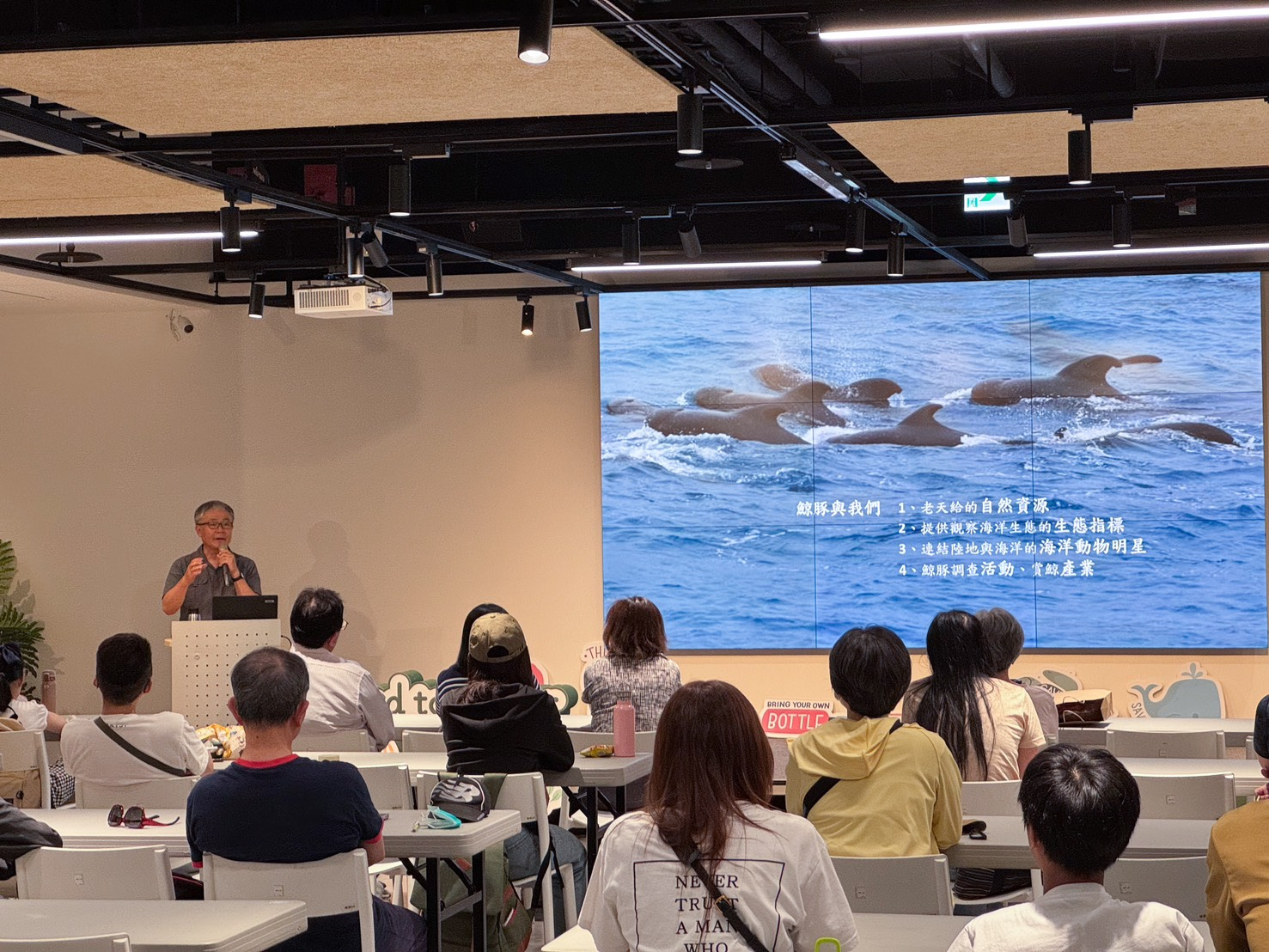
Speaker: Hung-Chi Liao
Taiwanese literary author. Formerly a fisherman, he has conducted marine ecological surveys on cetaceans, developed whale-watching programs, and served as the founding chairman of the Kuroshio Ocean Education Foundation. He has voyaged with squid-fishing vessels, joined container ships on European routes, and carried out projects such as the “Island Circumnavigation” and “Kuroshio 101 Drift Project.”
Selected Works
- Fishermen of the Sea (Morning Star, June 29, 1996)
- Whales in Life, Whales in the World (Morning Star, June 30, 1997)
- Drifting Prison (Morning Star, April 30, 1998)
- From the Deep Sea (Morning Star, February 28, 1999)
- The Coastal Town by the Mountains and Sea (Spring Wind, October 1, 2000)
- Ocean Rangers: Whales and Dolphins at Taiwan’s Tail (INK, October 16, 2001)
- Blue Pacific on Highway 11 (Unitas, February 28, 2003)
- Drifting Island: A Voyage Narrative (INK, December 24, 2003)
- In Search of an Island (Morning Star, March 14, 2005)
- Footprints and Wakes (INK, April 14, 2006)
- Floating Across the Ocean and Sky (Unitas, October 17, 2006)
- Sailing for New Territories (Unitas, June 14, 2007)
- Whale Tales from the East Coast (Unitas, February 4, 2008)
- South of the South: Notes from the National Museum of Marine Biology & Aquarium (Unitas, September 1, 2009)
- Flying Fish・Lily (Yulu, December 28, 2009)
- Escaping Fish: Voyage after Voyage toward the Quiet Sea (Yulu, July 4, 2011)
- Back to the Coastline (Unitas, February 1, 2012)
- Big Island, Small Island (Yulu, May 8, 2015)
- Sea Child: A Drifting Imagination Journal (Yulu, July 8, 2016)
- Kuroshio Drifting (Yulu, February 9, 2018)
- The Sixteen-Year-Old’s Ocean Lessons (Azure, July 5, 2019)
- Meeting Hua Xiaoxiang: The Deep-Sea Goodwill Ambassador (Yulu, July 13, 2019)
- 23.97°: Lessons in Ocean Philosophy (Youth Cultural, November 10, 2020)
- The Last Ocean Hunters (Lien Ching, January 6, 2022)
- Fish Dreams: A-Liao’s Stories of Fish (Yulu, June 17, 2022)